
Corporate Tax Filing Canada: A Complete Guide for Businesses
Learn how corporate tax filing Canada works, who must file, required documents, CRA deadlines, and how professional tax services help businesses stay compliant.
7/22/20266 min read
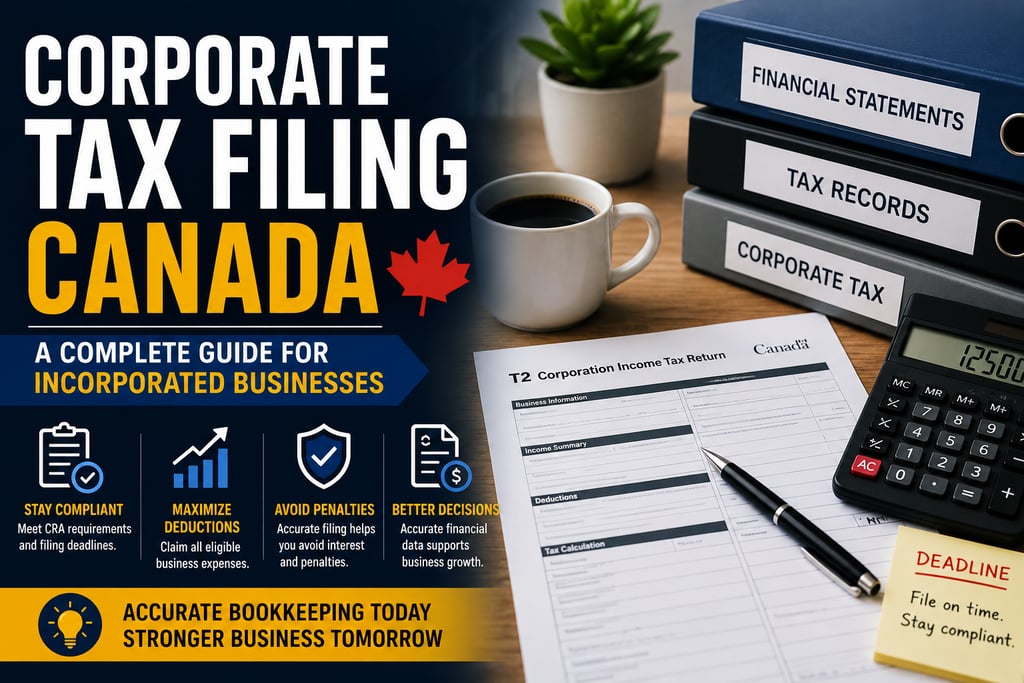
For incorporated businesses, corporate tax filing Canada is more than an annual obligation—it's an essential part of maintaining financial health and complying with Canada Revenue Agency (CRA) regulations. Filing an accurate corporate tax return helps businesses report income correctly, claim eligible deductions, and avoid unnecessary interest charges or penalties.
Whether you operate a small corporation, a growing startup, or an established company, understanding the corporate tax filing process can save time, reduce stress, and improve financial decision-making. Combined with accurate bookkeeping, proper tax filing ensures your business remains organized and prepared throughout the year.
In this guide, we'll explain what corporate tax filing involves, who needs to file, and the information required to complete an accurate corporate tax return.
What Is Corporate Tax Filing?
Corporate tax filing is the process of preparing and submitting a corporate income tax return to the Canada Revenue Agency (CRA). Every incorporated business in Canada has tax reporting obligations, regardless of whether it earned a profit during the year.
The purpose of a corporate tax return is to report your company's financial activities, calculate taxable income, claim eligible deductions, and determine the amount of tax payable.
Unlike personal income tax returns, corporate tax filings are based on a corporation's financial records rather than an individual's income. Accurate bookkeeping throughout the year plays a critical role in ensuring the information reported is complete and correct.
Who Must File a Corporate Tax Return?
Generally, every corporation resident in Canada must file a corporate income tax return each tax year.
This includes:
Canadian-controlled private corporations (CCPCs)
Small incorporated businesses
Professional corporations
Non-profit corporations with filing obligations
Inactive corporations
Corporations with little or no business activity
Even if your corporation has no tax owing, the CRA may still require an annual corporate tax return to be filed.
Corporate Tax vs Personal Tax
Many new business owners confuse corporate tax with personal income tax, but they are separate filing requirements.
Corporate tax applies to incorporated businesses and reports the corporation's income, expenses, assets, and taxable profits.
Personal tax applies to individuals and reports employment income, investment income, self-employment income, and other personal sources of revenue.
If you're both a shareholder and an employee of your corporation, you may have both personal and corporate tax filing responsibilities.
CRA Requirements
The CRA requires corporations to maintain accurate financial records that support the information reported on their tax returns.
Businesses should retain documentation such as:
Financial statements
Sales records
Expense receipts
Payroll records
GST/HST documentation
Bank statements
Corporate records
Well-organized financial information makes tax filing more efficient and helps businesses respond quickly if the CRA requests supporting documentation.
Who Needs to File Corporate Taxes in Canada?
Many business owners assume only profitable corporations need to file taxes. In reality, most incorporated businesses have annual filing obligations regardless of their income level.
Incorporated Businesses
Any business that has been legally incorporated in Canada is generally required to submit a corporate income tax return each year.
This applies whether the business operates locally, provincially, or nationally.
Small Corporations
Small businesses that have incorporated receive many advantages, including limited liability and potential tax planning opportunities.
However, incorporation also creates additional reporting responsibilities, including annual corporate tax filing and maintaining accurate financial records.
Canadian-Controlled Private Corporations (CCPCs)
Many small businesses in Canada operate as Canadian-Controlled Private Corporations (CCPCs).
These corporations may qualify for certain tax benefits, including the Small Business Deduction, provided they meet CRA eligibility requirements.
Proper bookkeeping and accurate financial reporting help ensure these benefits can be claimed correctly.
Inactive Corporations
Even if a corporation has not generated revenue or conducted business during the year, filing obligations may still apply.
Many inactive corporations are required to submit annual corporate tax returns until they are formally dissolved.
Failing to file because "nothing happened" can still result in CRA penalties or compliance issues.
Filing Obligations Even When No Tax Is Owed
A common misconception is that corporations only file taxes when they owe money.
In fact, corporations are generally expected to file their returns on time regardless of whether:
They earned a profit
They experienced a loss
No tax is payable
Business activity was limited
Meeting filing deadlines helps maintain good standing with the CRA and avoids unnecessary penalties.
What Information Is Required for Corporate Tax Filing?
Preparing an accurate corporate tax return begins with complete and organized financial records. Businesses that maintain their bookkeeping throughout the year typically find the filing process much smoother and more efficient.
Financial Statements
Corporate tax returns rely on accurate financial statements that summarize your company's financial performance.
These commonly include:
Income Statement (Profit and Loss Statement)
Balance Sheet
Statement of Retained Earnings
Cash Flow information
These reports provide the financial data used to calculate taxable income and support your corporate tax return.
Income and Expense Records
Every source of business income and every eligible expense should be properly recorded.
Examples include:
Sales revenue
Service income
Office expenses
Professional fees
Vehicle expenses
Equipment purchases
Marketing costs
Accurate income and expense tracking helps ensure the corporation reports taxable income correctly while claiming all eligible business deductions.
Bookkeeping Records
Consistent bookkeeping provides the foundation for successful corporate tax filing.
Well-maintained records include:
Bank reconciliations
General ledger transactions
Accounts receivable
Accounts payable
Monthly financial reports
Keeping these records current throughout the year significantly reduces errors during tax preparation.
Payroll Information
If your corporation employs staff, payroll records should also be complete and accurate.
Important payroll information includes:
Employee wages
CPP contributions
EI premiums
Income tax deductions
Payroll remittances
T4 information
Proper payroll bookkeeping supports both corporate tax reporting and CRA compliance.
GST/HST Records and Supporting Documents
Corporations registered for GST/HST should maintain organized records of taxes collected and paid.
Supporting documents should include:
GST/HST returns
Input Tax Credit records
Customer invoices
Supplier invoices
Bank statements
Expense receipts
Accurate bookkeeping ensures these records are readily available when preparing a corporate tax return and helps reduce the likelihood of filing errors.
Common Corporate Tax Filing Mistakes
Even businesses with good intentions can make mistakes when preparing their corporate tax returns. Many of these errors stem from incomplete bookkeeping, misunderstanding CRA requirements, or waiting until the filing deadline to organize financial records.
Avoiding these common mistakes can help your business remain compliant while reducing the risk of penalties and unnecessary stress.
Missing Filing Deadlines
One of the most expensive mistakes is filing your corporate tax return late.
Late filing may result in:
CRA penalties
Interest charges on unpaid taxes
Additional administrative costs
Increased stress during tax season
Maintaining organized bookkeeping throughout the year gives you enough time to prepare your return before the deadline.
Incomplete Financial Records
Corporate tax returns rely on accurate financial information.
Incomplete bookkeeping often leads to:
Missing income
Unrecorded expenses
Inaccurate financial statements
Additional work before filing
Keeping your books updated monthly helps ensure the information reported to the CRA is complete and accurate.
Incorrect Expense Claims
Businesses sometimes claim expenses that are not deductible or fail to claim legitimate business expenses.
Examples include:
Personal purchases recorded as business expenses
Unsupported expense claims
Incorrect capital asset treatment
Missing documentation
Proper bookkeeping and professional guidance help maximize eligible deductions while reducing the risk of CRA adjustments.
Poor Bookkeeping Throughout the Year
Many corporations only organize their financial records when tax season arrives.
Unfortunately, this often results in:
Missing receipts
Duplicate transactions
Incorrect account balances
Delayed tax preparation
Consistent bookkeeping throughout the year makes corporate tax filing significantly more efficient.
Ignoring CRA Notices
Businesses should never ignore correspondence from the CRA.
CRA notices may include:
Requests for additional information
Filing reminders
Balance notices
Reassessments
Compliance updates
Responding promptly helps prevent additional penalties or complications.
Filing Inaccurate Returns
Errors in corporate tax returns may result from incorrect calculations, missing information, or incomplete financial records.
An inaccurate return can lead to:
CRA reviews
Amended returns
Interest charges
Penalties
Delayed processing
Reviewing financial information carefully before filing helps minimize these risks.
Benefits of Professional Corporate Tax Filing Services
Preparing a corporate tax return requires careful attention to detail. Working with experienced professionals helps businesses meet their tax obligations while improving financial accuracy.
Professional corporate tax services provide several important advantages.
Maintain CRA Compliance
Tax professionals understand current CRA reporting requirements and help ensure returns are prepared accurately and submitted on time.
This reduces the likelihood of penalties and unnecessary correspondence with the CRA.
Accurate Financial Reporting
Professional tax preparation starts with organized bookkeeping and reliable financial statements.
Accurate reporting helps ensure:
Income is reported correctly
Eligible deductions are claimed
Supporting documentation is complete
Financial statements are consistent
Reliable records also support better financial planning throughout the year.
Maximize Eligible Business Deductions
Many corporations miss opportunities to reduce taxable income because expenses are not properly recorded or categorized.
Professional guidance helps businesses identify eligible deductions while ensuring claims comply with CRA regulations.
Save Valuable Time
Corporate tax preparation can be time-consuming, especially for growing businesses.
Outsourcing tax preparation allows owners to focus on:
Serving customers
Managing employees
Growing the business
Strategic planning
Rather than spending hours organizing financial information, business owners can concentrate on operations.
Reduce Stress and Improve Financial Planning
Knowing that experienced professionals are managing your corporate tax filing provides peace of mind.
Professional support also helps businesses:
Prepare for future tax obligations
Improve bookkeeping processes
Understand financial performance
Plan for sustainable growth
How TiKi Tax Supports Canadian Businesses
Corporate tax filing becomes much easier when supported by accurate bookkeeping and experienced professionals.
At TiKi Tax, we help incorporated businesses across Kelowna, Penticton, West Kelowna, Summerland, Peachland, Oliver, Osoyoos, and Lake Country manage their financial responsibilities with confidence.
Our team provides:
Corporate tax filing services
Business tax services
Professional bookkeeping
GST/HST filing support
Payroll services
Financial statement preparation
Personalized tax planning guidance
We combine organized bookkeeping with CRA-compliant tax preparation to help businesses maintain accurate financial records throughout the year. This proactive approach reduces last-minute stress, improves reporting accuracy, and allows business owners to focus on growing their companies.
Whether you're a newly incorporated startup or an established corporation, TiKi Tax provides practical support tailored to your business's unique needs.
Conclusion
Understanding corporate tax filing Canada is essential for every incorporated business. Filing an accurate corporate tax return isn't simply about meeting a CRA deadline—it's an opportunity to maintain organized financial records, claim eligible deductions, and make informed business decisions.
Businesses that maintain accurate bookkeeping throughout the year are better prepared for corporate tax filing, experience fewer reporting errors, and reduce the risk of penalties or interest charges.
If your corporation needs assistance with bookkeeping, corporate tax preparation, or ongoing tax planning, TiKi Tax is here to help. Our experienced team supports businesses across British Columbia with reliable, CRA-compliant solutions that simplify tax filing and support long-term business success.
TiKi Tax
© 2025. All rights reserved.