
Tax Filing vs Bookkeeping: What's the Difference for Canadian Businesses?
Learn the difference between tax filing vs bookkeeping, why Canadian businesses need both, and how proper bookkeeping makes tax season easier and CRA compliant.
7/20/20268 min read
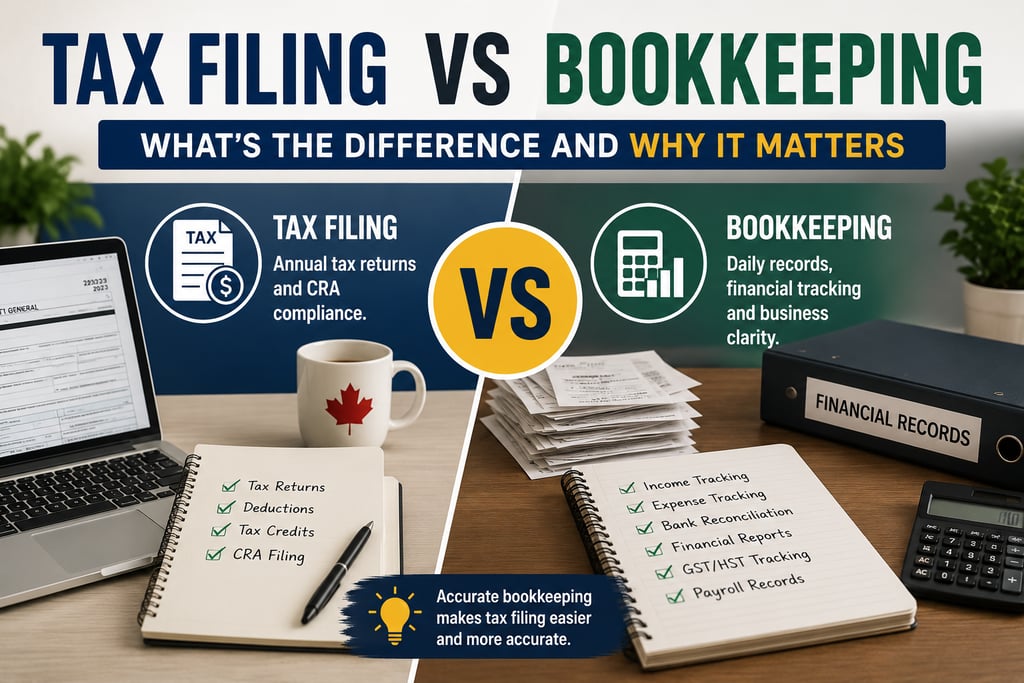
Many Canadian business owners use the terms bookkeeping and tax filing interchangeably, but they serve very different purposes. Understanding tax filing vs bookkeeping is essential for keeping your finances organized, making informed business decisions, and staying compliant with Canada Revenue Agency (CRA) requirements.
Bookkeeping is an ongoing process that records and organizes your financial transactions throughout the year. Tax filing, on the other hand, uses those financial records to prepare and submit tax returns to the CRA. Without accurate bookkeeping, tax filing becomes more difficult, time-consuming, and prone to errors.
Whether you're a small business owner, contractor, freelancer, or entrepreneur in British Columbia, knowing how these two services work together can help you save time, reduce stress, and improve your financial management.
What Is Bookkeeping?
Bookkeeping is the process of recording, organizing, and maintaining a business's financial transactions. It provides a clear picture of your company's financial health and serves as the foundation for accurate financial reporting and tax preparation.
Rather than being a once-a-year task, bookkeeping should be completed consistently throughout the year to ensure your records remain accurate and up to date.
Recording Daily Financial Transactions
Every business transaction should be recorded promptly.
This includes:
Customer payments
Sales revenue
Supplier invoices
Business purchases
Operating expenses
Loan payments
Recording transactions regularly ensures that your financial records accurately reflect your business activity.
Tracking Income and Expenses
One of the primary responsibilities of bookkeeping is tracking where money comes from and where it goes.
Accurate income and expense tracking helps businesses:
Monitor profitability
Control spending
Identify unnecessary costs
Create realistic budgets
Prepare for tax season
Without reliable bookkeeping, it's difficult to understand whether your business is truly profitable.
Bank Reconciliations
Bookkeepers compare accounting records with bank statements every month to ensure all transactions have been recorded correctly.
Bank reconciliation helps identify:
Missing deposits
Duplicate transactions
Banking errors
Outstanding payments
Incorrect account balances
Regular reconciliations improve the accuracy of your financial records and reduce the risk of costly mistakes.
Payroll Records
If your business has employees, bookkeeping also includes maintaining accurate payroll records.
This involves:
Employee wages
CPP contributions
EI deductions
Income tax withholdings
Vacation pay
Payroll remittances
Accurate payroll bookkeeping helps businesses meet CRA reporting requirements while ensuring employees are paid correctly and on time.
GST/HST Tracking
Businesses registered for GST/HST must keep accurate records of taxes collected from customers and taxes paid on eligible business expenses.
Monthly GST/HST tracking allows businesses to:
Calculate tax obligations accurately
Claim eligible Input Tax Credits (ITCs)
Prepare GST/HST returns
Reduce filing errors
Maintaining organized GST/HST records throughout the year makes filing significantly easier.
Financial Reporting
Bookkeeping also produces financial reports that help business owners understand overall performance.
Common reports include:
Profit and Loss Statement
Balance Sheet
Cash Flow Statement
Accounts Receivable Report
Accounts Payable Report
These reports provide valuable insights into profitability, cash flow, and financial stability, helping owners make informed decisions about growth and investments.
What Is Tax Filing?
While bookkeeping focuses on recording financial activity, tax filing involves preparing and submitting required tax returns to the Canada Revenue Agency using those financial records.
Tax filing ensures individuals and businesses report income accurately, claim eligible deductions, and meet all applicable filing deadlines.
Personal Tax Returns
Individuals, self-employed professionals, and sole proprietors must file annual personal income tax returns.
These returns report:
Employment income
Business income
Investment income
Eligible deductions
Tax credits
Accurate bookkeeping simplifies this process by ensuring income and expenses are properly documented.
Business Tax Returns
Businesses must report their financial results to the CRA each year.
Depending on the business structure, this may include:
Sole proprietorship reporting
Partnership reporting
Business income statements
Expense reporting
Tax calculations
Well-maintained bookkeeping records make business tax preparation faster and more accurate.
Corporate Tax Filing
Incorporated businesses are required to file corporate income tax returns annually.
Corporate tax filing typically involves:
Financial statements
Corporate income calculations
Business deductions
Capital asset reporting
Tax payable calculations
Because corporate tax rules can be complex, accurate bookkeeping throughout the year is essential.
GST/HST Filing
Businesses registered for GST/HST must submit returns according to their assigned filing frequency.
GST/HST filing includes:
Reporting GST/HST collected
Claiming Input Tax Credits
Calculating net tax payable
Submitting returns to the CRA
Accurate bookkeeping helps ensure GST/HST returns are completed correctly and filed on time.
CRA Reporting Requirements and Tax Deadlines
The CRA requires businesses to meet various reporting obligations throughout the year.
Depending on your business, these may include:
Annual income tax returns
Corporate tax returns
GST/HST returns
Payroll remittances
Information slips and summaries
Missing filing deadlines can result in interest charges and penalties, making organized financial records even more important.
Tax Filing vs Bookkeeping: Key Differences
Understanding tax filing vs bookkeeping becomes much easier when you compare the purpose of each service.
Bookkeeping is an ongoing financial management process. It focuses on recording daily transactions, organizing financial information, reconciling accounts, tracking GST/HST, processing payroll, and producing monthly financial reports. It provides business owners with accurate financial data throughout the year and supports informed decision-making.
Tax filing, by contrast, is the process of preparing and submitting tax returns to the CRA based on the financial information generated through bookkeeping. Its primary purpose is to ensure compliance with Canadian tax laws, calculate tax obligations correctly, and claim eligible deductions and credits.
The two services also differ in frequency. Bookkeeping should be completed regularly—ideally daily, weekly, or monthly—while tax filing occurs according to CRA deadlines, such as annual income tax returns, corporate tax filings, or scheduled GST/HST returns.
Another important distinction is responsibility. A bookkeeper maintains accurate financial records and ensures transactions are properly categorized, while a tax professional or accountant uses those records to prepare tax returns and provide tax planning advice.
Ultimately, bookkeeping and tax filing are complementary rather than competing services. Accurate bookkeeping provides the reliable financial information needed for efficient, accurate, and compliant tax filing. Businesses that maintain organized books throughout the year are better prepared for tax season, experience fewer filing errors, and gain a clearer understanding of their financial performance.
Why Small Businesses Need Both
Many small business owners assume that tax filing is the only financial task that matters. In reality, bookkeeping and tax filing work together to support the financial health of your business. One without the other often leads to inaccurate records, missed opportunities, and unnecessary stress.
Maintain CRA Compliance
The Canada Revenue Agency (CRA) requires businesses to maintain accurate financial records that support reported income, expenses, payroll, and GST/HST filings.
Consistent bookkeeping helps ensure:
Transactions are recorded correctly
Supporting documents are organized
GST/HST records are accurate
Payroll information is complete
Tax returns are based on reliable financial data
Maintaining organized books throughout the year makes CRA compliance much easier.
Make Better Financial Decisions
Bookkeeping provides real-time financial information that helps business owners make informed decisions.
Monthly financial reports allow you to answer important questions such as:
Is the business profitable?
Can we afford to hire another employee?
Are operating expenses increasing?
Is cash flow improving?
Should we invest in new equipment?
Without accurate bookkeeping, these decisions are based on guesswork rather than facts.
Reduce Tax Filing Errors
Many tax filing mistakes occur because financial records are incomplete or inaccurate.
Professional bookkeeping helps ensure:
Income is reported correctly
Business expenses are categorized properly
GST/HST balances are accurate
Payroll information is complete
Financial statements are reliable
Accurate bookkeeping reduces the likelihood of filing amendments, penalties, or CRA inquiries.
Improve Cash Flow Management
Bookkeeping isn't just about taxes—it also helps businesses monitor cash flow throughout the year.
By regularly reviewing financial reports, business owners can:
Identify overdue customer invoices
Monitor upcoming bills
Control operating expenses
Plan for seasonal fluctuations
Maintain healthy working capital
Good cash flow management contributes directly to long-term business success.
Reduce Stress During Tax Season
Businesses that keep their books updated throughout the year avoid the last-minute rush of gathering receipts and organizing financial records before filing deadlines.
Instead, tax preparation becomes a straightforward process because the necessary information is already available and organized.
Common Mistakes Businesses Make
Even well-managed businesses can develop bookkeeping habits that create problems during tax season. Avoiding these common mistakes can save both time and money.
Waiting Until Tax Season
One of the biggest mistakes is postponing bookkeeping until taxes are due.
This often leads to:
Missing receipts
Incomplete financial records
Rushed tax preparation
Increased accounting costs
Greater risk of filing errors
Updating your books monthly is far more efficient than trying to organize an entire year's transactions at once.
Poor Record Keeping
Incomplete records make it difficult to prepare accurate tax returns.
Examples include:
Missing invoices
Unrecorded expenses
Lost receipts
Inaccurate bank records
Maintaining organized financial documents throughout the year simplifies bookkeeping and tax filing.
Mixing Personal and Business Expenses
Using the same bank account or credit card for personal and business purchases creates unnecessary confusion.
Keeping finances separate makes it easier to:
Track deductible expenses
Prepare financial statements
Complete tax returns
Respond to CRA requests
Separate accounts also provide a clearer picture of your business performance.
Ignoring Bookkeeping Throughout the Year
Bookkeeping is an ongoing responsibility—not a once-a-year task.
Ignoring it can result in:
Poor cash flow visibility
Inaccurate financial reports
Missed tax deductions
Compliance issues
Stress during tax season
Developing a consistent bookkeeping routine keeps your business organized and prepared year-round.
How TiKi Tax Helps Businesses Stay Organized
Managing bookkeeping and tax obligations can be challenging, especially for busy entrepreneurs focused on growing their businesses. Partnering with experienced professionals helps ensure your financial records remain accurate while reducing administrative workloads.
At TiKi Tax, we support businesses throughout Kelowna, Penticton, West Kelowna, Summerland, Peachland, Lake Country, Oliver, and Osoyoos with practical bookkeeping and tax solutions tailored to their needs.
Our services include:
Professional bookkeeping services
Small business bookkeeping
Personal tax filing
Corporate tax filing
GST/HST filing support
Payroll services
Financial statement preparation
Ongoing CRA compliance assistance
Using modern cloud accounting tools and personalized support, we help business owners stay organized throughout the year so tax season becomes simpler and less stressful.
Whether you're launching a startup, operating a growing company, or working as a self-employed professional, our team provides reliable financial support that allows you to focus on running your business with confidence.
Tips to Make Tax Season Easier
A little preparation each month can make tax season significantly less stressful.
Keep Your Bookkeeping Updated Monthly
Record income, expenses, payroll, and bank transactions every month instead of waiting until year-end.
Store Receipts Digitally
Use cloud accounting software or secure digital storage to organize receipts and invoices, making them easy to access whenever needed.
Review Financial Reports Regularly
Monitor your Profit and Loss Statement, Balance Sheet, and Cash Flow Statement each month to understand your business performance and identify issues early.
Track GST/HST Carefully
If your business is registered for GST/HST, record taxes collected and paid throughout the year to simplify filing and reduce errors.
Work With Professionals Before Deadlines
Seeking professional advice before filing deadlines allows time to review records, correct mistakes, and ensure all reporting requirements are met accurately.
Conclusion
Understanding tax filing vs bookkeeping is essential for every Canadian business owner. While bookkeeping focuses on recording and organizing financial information throughout the year, tax filing uses those records to prepare and submit accurate returns to the Canada Revenue Agency.
Together, these services help businesses stay compliant, improve financial decision-making, reduce tax filing errors, and maintain healthy cash flow. Businesses that invest in consistent bookkeeping are better prepared for tax season and spend less time dealing with avoidable financial issues.
If you're looking for reliable support with bookkeeping, GST/HST, payroll, or tax filing, TiKi Tax is here to help. Our experienced team works with businesses across British Columbia to keep financial records organized and ensure tax obligations are handled accurately and on time. Contact TiKi Tax today to learn how professional bookkeeping and tax filing services can support your business's long-term success.
Frequently Asked Questions
1. What is the difference between bookkeeping and tax filing?
Bookkeeping involves recording and organizing daily financial transactions, while tax filing is the process of preparing and submitting tax returns to the CRA using those financial records.
2. Do I need bookkeeping before filing taxes?
Yes. Accurate bookkeeping provides the financial information needed to prepare complete and accurate tax returns, making tax filing more efficient and reducing the risk of errors.
3. Can a bookkeeper prepare tax returns?
A bookkeeper maintains financial records and prepares reports that support tax filing. Depending on their qualifications and the services they offer, some bookkeepers may assist with tax preparation, while more complex tax matters are often handled by accountants or tax professionals.
4. How often should bookkeeping be updated?
Bookkeeping should ideally be updated monthly—or even weekly for businesses with a high volume of transactions—to keep financial records accurate and up to date.
5. Why is bookkeeping important for tax filing?
Bookkeeping ensures income, expenses, payroll, and GST/HST records are accurate. These records form the foundation of accurate tax returns and help businesses remain compliant with CRA requirements.
TiKi Tax
© 2025. All rights reserved.