
Understanding Vehicle Expenses: Logbooks, CCA, and Pro-Rating
Learn how to claim vehicle expenses for your small business in Canada. Understand logbooks, CCA (depreciation), and how to pro-rate business use correctly to stay compliant with CRA.
10/21/20252 phút đọc
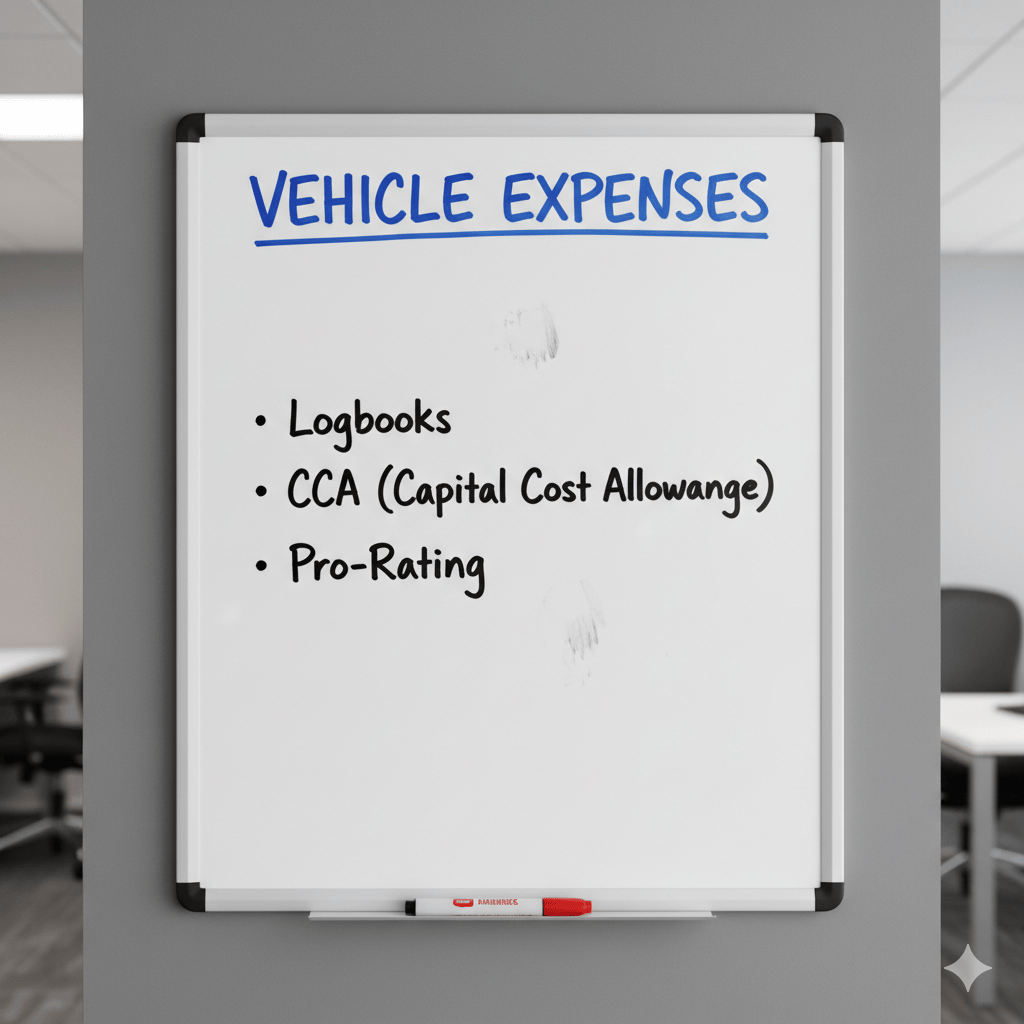
If you use your car for both business and personal purposes, the Canada Revenue Agency (CRA) requires you to claim only the business-use portion of your vehicle expenses.
That means you’ll need to track your mileage, understand how CCA (Capital Cost Allowance) works, and pro-rate your costs properly. Let’s break it all down step by step.
1. Keep a Logbook – It’s Your Best Friend
Your logbook is the most important piece of evidence when claiming vehicle expenses. It shows how much of your total driving is business-related.
Each trip should include:
The date of the trip
The destination
The purpose of the trip
The distance (km) driven
At the end of the year, calculate your business-use percentage:
Business km ÷ Total km = Business-use %
💡 Tip: You only need to keep a full-year logbook once. After that, you can use a 3-month sample logbook to estimate future years — as long as your business driving pattern stays consistent.
2. What Vehicle Expenses You Can Claim
You can deduct the business portion of most vehicle-related costs, including:
Gas and oil
Insurance
Repairs and maintenance
License and registration
Lease payments (subject to CRA limits)
Interest on car loans
Capital Cost Allowance (CCA) if you own the car
But remember — personal driving is not deductible. Only the percentage used for business applies.
3. Understanding CCA (Depreciation)
If you own the vehicle, you can’t deduct the full cost all at once. Instead, you claim CCA, which spreads out the cost over several years.
Most passenger vehicles fall under:
Class 10 or 10.1 – standard cars
Class 54 – zero-emission vehicles
The CRA sets annual CCA limits. For example, passenger vehicles generally have a maximum cost limit of $30,000 + tax eligible for CCA.
💡 Tip: You only claim CCA on the business-use portion of your car. For example, if your car is 60% business use, you can claim 60% of the CCA amount.
4. Pro-Rating Your Vehicle Expenses
Once you’ve figured out your business-use percentage, apply it across all vehicle expenses.
Example:
Total gas, insurance, repairs, etc. = $6,000
Business-use = 60%
✅ Claimable vehicle expenses = $6,000 × 60% = $3,600
Do the same calculation for CCA and any other vehicle-related costs.
5. Common Mistakes to Avoid
🚫 Estimating business use without a logbook
🚫 Claiming 100% of vehicle expenses when the car is also used personally
🚫 Forgetting to keep receipts or digital records
🚫 Double-claiming CCA and lease payments
CRA often audits vehicle expense claims — and your logbook is your best defense.
6. Keep It Clean and Simple
Maintaining your logbook, tracking receipts, and updating mileage may sound tedious — but it protects you at tax time and maximizes your deductions legally.
At Tiki Tax, we help small business owners set up easy logbook systems, calculate accurate CCA, and pro-rate expenses correctly — so you get every dollar you’re entitled to without CRA headaches.
Keywords:
vehicle expenses Canada, CRA logbook rules, claim CCA car, business-use vehicle tax, pro-rate car expenses, small business tax deductions Canada
TiKi Tax
© 2025. All rights reserved.